What Is CBD Edible?
Food becomes a carrier for chemistry.
A Format Defined by Ingestion Rather Than Extraction
CBD edibles are food-based products infused with cannabidiol, designed for oral consumption. They are not concentrates, not tinctures, and not vaporized formats. Edibles represent a delivery system where CBD is incorporated into a food matrix – solid, semi-solid, or liquid – and consumed as part of a culinary or nutritional experience.
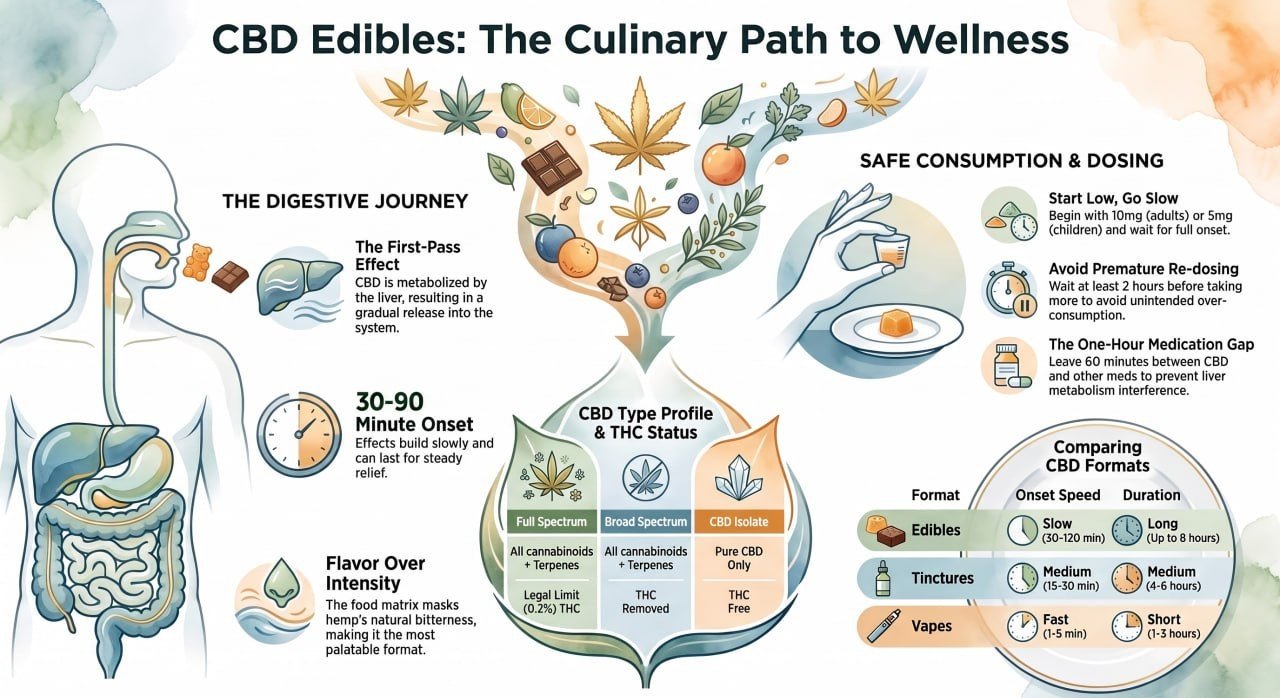
CBD enters the body through the digestive pathway rather than inhalation or sublingual absorption. Because ingestion relies on digestion and liver metabolism (the first-pass effect), onset is naturally gradual – often taking 30 to 120 minutes – and is paired with a longer, steadier duration. This slow build is natural.
Because edibles take time to move through digestion and liver metabolism, users should avoid taking additional servings during this period. Premature redosing can lead to unintended overconsumption once the effects fully activate. Beginning with a low serving and allowing adequate time for onset is the most responsible approach.
Because edibles undergo first-pass metabolism, their systemic bioavailability is naturally lower than inhalable or sublingual formats – another reason to begin with modest servings.
This shift defines the format, shaping onset, duration, and formulation requirements.
Where CBD Edibles Begin: Extract Meets Food Matrix
CBD edibles begin with a CBD ingredient – isolate, broad-spectrum extract, full-spectrum extract, distillate, or water-soluble CBD. This ingredient is incorporated into a food base such as gelatin, chocolate, baked dough, carrier oils, or – when processed via specialized emulsification techniques – infused beverages.
CBD is not altered by being added to food, though heat and light can degrade it, which is why formulation matters. What changes is the environment around it. The food matrix becomes the carrier, determining how CBD disperses, stabilizes, and interacts with other ingredients.
Edibles are therefore not a new type of CBD. They are a new context for CBD.
Why Edibles Matter: Integration Into Daily Rituals
Edibles offer a delivery format that integrates CBD into familiar routines – eating, drinking, snacking. They do not require specialized equipment, inhalation, or measurement. Their appeal lies in simplicity and familiarity. The food matrix masks the natural bitterness of hemp extracts, making edibles accessible to users who prefer neutral or pleasant flavors.
Edibles are defined by experience, not intensity.
How CBD Edibles Are Made: Infusion and Stabilization
CBD edibles are produced through a multi-stage process:
- Selection of CBD ingredient;
- Infusion – blending CBD into the food matrix;
- Homogenization – ensuring even distribution;
- Stabilization – preventing separation or degradation;
- Shaping – forming gummies, chocolates, baked goods, or beverages;
- Packaging – protecting freshness and consistency.
The infusion step is critical. CBD must be evenly dispersed to ensure consistent dosing. Stabilization prevents CBD from separating, crystallizing, or degrading within the food.
Edibles are therefore a product of formulation science rather than extraction science.
What CBD Edibles Contain: Food Matrix Plus Cannabidiol
CBD edibles contain:
- CBD – isolate, broad-spectrum, full-spectrum, or distillate;
- Food ingredients – sugars, fats, proteins, starches, or liquids;
- Optional terpenes – added for flavor or aroma;
- Optional minor cannabinoids – present in full-spectrum or broad-spectrum edibles;
- Optional functional ingredients – vitamins, botanicals, or flavorings.
They do not contain waxes or lipids from raw extract unless intentionally added. Their composition depends entirely on the chosen CBD ingredient and food base.
CBD Edibles vs CBD Gummies: Category vs Subcategory
CBD edibles are the broad category. CBD gummies are a specific type of edible made with gelatin or pectin. Gummies are chewy and uniform. Edibles include chocolates, baked goods, beverages, candies, and more.
Gummies are structured. Edibles are diverse.
CBD Edibles vs CBD Capsules: Food vs Encapsulation
CBD capsules contain CBD in a gelatin or plant-based shell. They are swallowed like supplements. Edibles are consumed as food.
Capsules are neutral and clinical. Edibles are sensory and culinary.
Capsules prioritize precision. Edibles prioritize experience.
CBD Edibles vs CBD Tinctures: Digestive vs Sublingual
CBD tinctures are absorbed under the tongue. Edibles are absorbed through digestion.
Tinctures offer faster onset. Edibles offer longer duration.
Tinctures are liquid. Edibles are food.
Their difference is defined by the route of administration.
CBD Edibles vs CBD Vape Products: Ingestion vs Inhalation
CBD vape products deliver CBD through inhalation. Edibles deliver CBD through ingestion.
Vape formats offer rapid onset. Edibles offer gradual onset.
Vape products require devices. Edibles require only consumption.
Edibles are accessible and equipment-free.
CBD Edibles vs CBD Beverages: Solid vs Liquid Food Matrix
CBD beverages are liquid edibles. They require water-soluble CBD or emulsified CBD to disperse evenly. Solid edibles use fats or sugars as carriers.
Both are ingested, but their formulation challenges differ.
Beverages prioritize dispersion. Solid edibles prioritize stability.
The Sensory Profile: Culinary, Familiar, Controlled
CBD edibles have a sensory identity shaped by their food matrix. They may be sweet, savory, creamy, chewy, or crisp. Their aroma depends on flavorings and terpenes. Their texture depends on formulation – gelatinous, crunchy, smooth, or liquid.
Edibles feel familiar. They behave like food.
How CBD Edibles Are Used: Consumption and Routine Integration
CBD edibles are consumed like any food product. They can be eaten with meals, as snacks, or as part of daily rituals. Their dosing is pre-measured, making them convenient for consistent use.
They require no preparation, equipment, or mixing, making them ideal for users who value simplicity. Because of their familiar food-like appearance, edibles should always be kept in child-resistant packaging and stored securely out of reach of children and pets.
Why People Choose CBD Edibles
CBD edibles appeal to users who value convenience, flavor, and familiarity. They offer a discreet, approachable way to consume CBD without inhalation or manual measurement. To ensure consistent quality and accurate per-serving dosing, consumers should always choose products verified by a third-party Certificate of Analysis (COA).
For some, edibles are the most pleasant CBD format. For others, they are the most convenient.
A Culinary Expression of Cannabidiol
In the end, CBD edibles are food products infused with cannabidiol. They are hemp chemistry integrated into culinary form. They are stable, approachable, and versatile – a format defined by ingestion rather than extraction.
CBD edibles are not concentrates. They are not tinctures. They are not vaporized. They are the plant’s molecule, carried by food.
General Safety Reminder
Individuals with medical conditions, those taking medications metabolized by liver enzymes, or those who are pregnant or nursing should consult a healthcare professional before using CBD edibles.[^1]
[^1]: Educational Disclaimer: This article is for general informational purposes only and has not been evaluated by the FDA, EFSA, or any other national regulatory authority. It is not medical advice and is not intended to diagnose, treat, cure, or prevent any disease or condition. Consult a qualified healthcare provider before using CBD, especially if you are pregnant, nursing, taking medication, or have a pre-existing medical condition.
