
What Is CBD Chocolate?
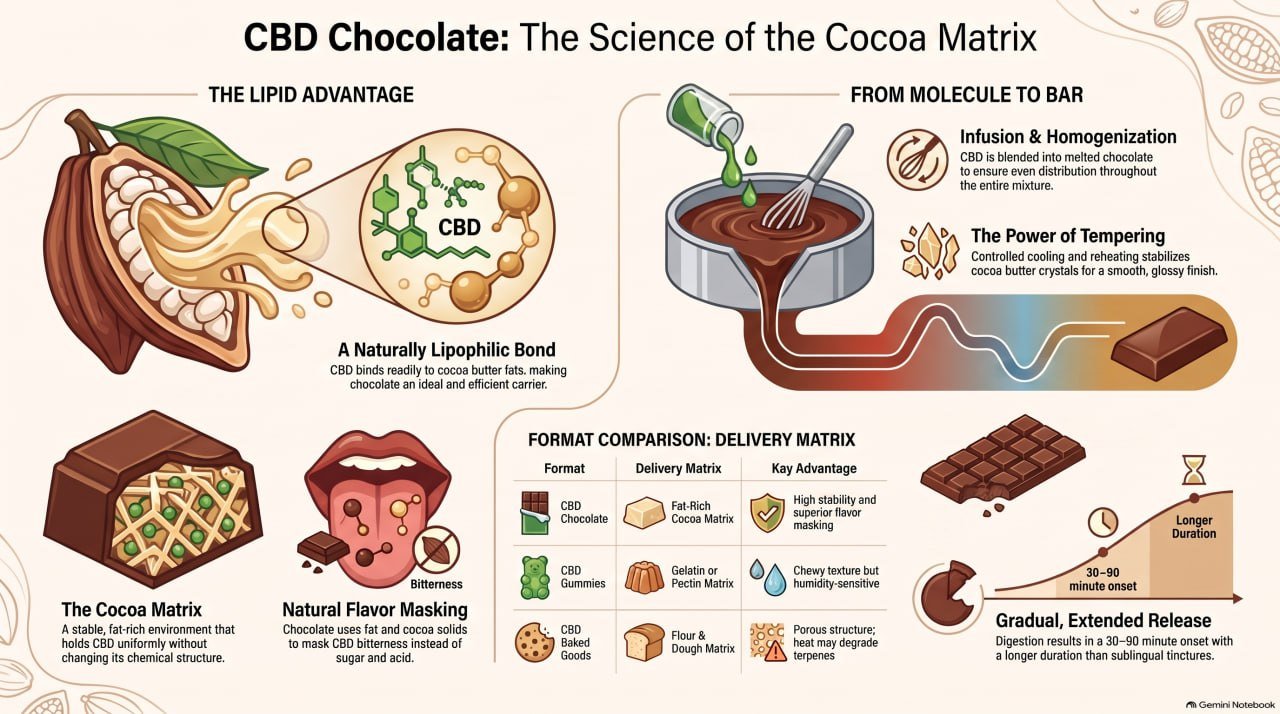
Cannabidiol carried by a fat-rich cocoa matrix.
A Format Defined by Lipid Integration and Culinary Structure
CBD chocolate is a confectionery product in which cannabidiol is infused into a cocoa matrix. It is not a gummy, not a tincture, and not a baked edible. Chocolate represents a unique edible format where CBD disperses within cocoa butter, vegetable fats, or chocolate compounds, creating a stable, flavorful, and familiar delivery system. Its identity lies in lipid integration: CBD dissolves readily in fats, making chocolate an efficient and elegant carrier.
Where CBD Chocolate Begins: CBD Ingredient Meets Cocoa Matrix
CBD chocolate begins with a CBD ingredient – isolate, broad-spectrum extract, full-spectrum extract, distillate, or water-soluble CBD. This ingredient is incorporated into melted chocolate, where the cocoa matrix acts as the dispersing medium. Cocoa butter, milk fats, and emulsifiers create a stable environment that holds CBD uniformly throughout the bar or piece.
CBD is not altered by being added to chocolate, though heat and light can degrade it, which is why formulation matters. What changes is the medium that carries it.
Chocolate is therefore not a new type of CBD. It is a cocoa matrix edible format.
Why Chocolate Matters: Fat as a Natural Carrier
CBD is lipophilic – it dissolves readily in fats. Chocolate is rich in fats, making it an ideal carrier for CBD. This natural compatibility improves dispersion, stability, and flavor masking. Chocolate also offers a familiar sensory experience, making CBD consumption approachable and enjoyable.
Chocolate is defined by structure and flavor, not intensity.
How CBD Chocolate Is Made: Tempering and Homogenization
CBD chocolate is produced through a multi-stage process:
- Selection of CBD ingredient – isolate, extract, or distillate;
- Melting – heating chocolate to create a fluid cocoa matrix;
- Infusion – blending CBD into the melted chocolate;
- Homogenization – ensuring even distribution throughout the mixture;
- Tempering – cooling and reheating to stabilize cocoa butter crystals;
- Molding – pouring into bars, squares, or shapes;
- Setting – cooling to solidify structure;
- Packaging – protecting freshness and preventing fat bloom.
Tempering is the defining step. It ensures chocolate has a smooth texture, glossy finish, and stable crystalline structure that holds CBD uniformly.
CBD chocolate is therefore a product of culinary chemistry and controlled fat crystallization.
What CBD Chocolate Contains: Cocoa Matrix Plus Cannabidiol
CBD chocolate contains:
- CBD – isolate, broad-spectrum, full-spectrum, or distillate;
- Cocoa solids – providing flavor and color;
- Cocoa butter – the primary fat carrier;
- Milk solids – in milk chocolate varieties;
- Sugars – sucrose, glucose, or alternatives;
- Emulsifiers – lecithin or similar agents;
- Flavorings – vanilla, spices, botanical extracts;
- Optional terpenes – added for aroma or strain-like profiles;
- Optional minor cannabinoids – present in broad-spectrum or full-spectrum chocolates (full-spectrum may contain compliant trace amounts of THC; always verify batch COAs for local compliance).
Standard CBD chocolate leverages lipophilic CBD ingredients like distillate or isolate, which naturally integrate into the cocoa matrix. For low-fat or specialty cocoa preparations, nano-emulsified water-soluble CBD ensures uniform dispersion without disrupting fat crystallization or causing bloom.
CBD Chocolate vs CBD Gummies: Fat-Rich Cocoa Matrix vs Gel Matrix
CBD gummies use gelatin or pectin as carriers. CBD chocolate uses a cocoa matrix.
- Gummies are chewy; chocolate is smooth;
- Gummies mask bitterness through sugar and acid; chocolate masks it through fat and cocoa solids;
- Gummies bounce; chocolate melts;
- Gummies are humidity-sensitive; chocolate is heat-sensitive.
Their difference is structural and functional.
CBD Chocolate vs CBD Edibles: Specific vs General Category
CBD edibles are the broad category of food-based CBD products. CBD chocolate is a specific edible structured through fat crystallization. Edibles include gummies, baked goods, beverages, candies, and more. Chocolate is uniform, stable, and rich.
Edibles are diverse. Chocolate is refined.
CBD Chocolate vs CBD Capsules: Culinary vs Clinical
CBD capsules contain CBD in a gelatin or plant-based shell. Chocolate is consumed as food. Capsules are neutral and clinical. Chocolate is sensory and indulgent.
Capsules prioritize simplicity. Chocolate prioritizes experience.
CBD Chocolate vs CBD Tinctures: Digestive vs Sublingual
CBD tinctures are absorbed under the tongue. CBD chocolate is absorbed through digestion.
Tinctures offer faster sublingual absorption. Chocolate relies on digestive processing and first-pass metabolism, resulting in a more gradual onset – typically 30 to 90 minutes – and extended duration.
Their difference is defined by the route of administration.
CBD Chocolate vs CBD Baked Goods: Fat Crystals vs Dough Matrix
CBD baked goods use flour, fats, and heat. CBD chocolate uses cocoa butter and tempering.
- Baked goods are porous; chocolate is dense;
- Baked goods require high heat that may degrade terpenes; chocolate uses lower temperatures that preserve aromatic compounds;
- Chocolate offers longer shelf stability.
Chocolate is structurally stable and shelf-friendly.
CBD Chocolate vs Water-Soluble CBD Products: Lipophilic vs Hydrophilic Systems
Standard CBD chocolate uses lipophilic CBD ingredients such as isolate or distillate. Water-soluble CBD chocolate uses nano-emulsified CBD to improve dispersion in low-fat chocolate varieties.
Standard chocolate prioritizes fat compatibility. Water-soluble chocolate prioritizes uniformity.
The Sensory Profile: Smooth, Rich, Fat-Structured
CBD chocolate has a sensory identity shaped by cocoa chemistry:
- smooth melt;
- dense, rich texture;
- deep aroma;
- glossy finish when tempered;
- flavor complexity from cocoa solids and added botanicals.
Chocolate feels indulgent and familiar.
How CBD Chocolate Is Used: Consumption and Routine Integration
CBD chocolate is consumed like any confectionery product. It can be eaten as a treat, part of a dessert, or integrated into daily rituals. Its dosing is pre-measured, making it convenient for consistent use. It requires no preparation, equipment, or mixing.
Because CBD chocolate resembles traditional confectionery, it must always be stored in child-resistant packaging and kept securely out of reach of children and pets.
Chocolate is ideal for users who prefer a pleasant, familiar format.
Why People Choose CBD Chocolate
CBD chocolate appeals to users who value:
- flavor;
- indulgence;
- smooth texture;
- discreet consumption;
- pre-measured dosing;
- a familiar, enjoyable format.
For some, chocolate is the most enjoyable CBD format. For others, it is the most elegant.
A Fat-Rich Cocoa Expression of Cannabidiol
CBD chocolate is cannabidiol embedded in a cocoa matrix. It is stable, indulgent, and precise – a format defined by fat crystallization rather than extraction.
CBD chocolate is not a tincture. It is not a concentrate. It is not vaporized. It is the plant’s molecule carried by cocoa.
Safety & Compliance Notice
- Intended for legal-age adults (21+ or per local jurisdiction).
- Consult a physician if pregnant, nursing, or taking prescription medications.
- Store securely in child-resistant packaging.
- Verify batch testing and compliant trace THC levels through a third-party Certificate of Analysis (COA).[^1]
[^1]: Educational Disclaimer: This article is for general informational purposes only and has not been evaluated by the FDA, EFSA, or any other national regulatory authority. It is not medical advice and is not intended to diagnose, treat, cure, or prevent any disease or condition. Consult a qualified healthcare provider before using CBD, especially if you are pregnant, nursing, taking medication, or have a pre-existing medical condition.
